
If you want to know more information, like quotation, products, solutions, etc., please contact us online.
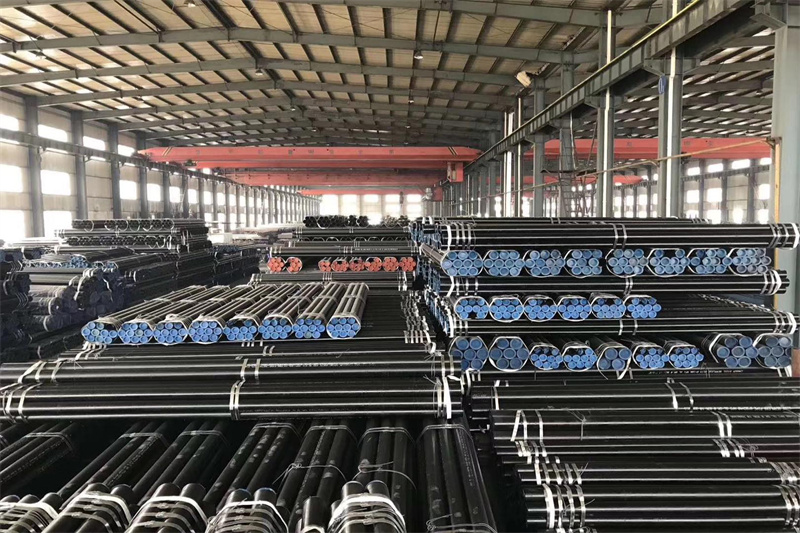
Tianjin Sanon Steel Pipe Co., Ltd. is a stockist. Our stock factory is in Cangzhou City, Hebei Province. Our main sources of goods are boiler pipes, and the representative materials are ASTM A335 P5/P11/P91/P92, ASME SA-106/SA-106M GR.B, GB/T 3087-2008 10#/20#. The representative materials of pipeline pipes are API 5L, API 5CT, the representative materials of petroleum cracking pipes GB/T 9948 are 15MoG/12CrMoVG. GB/T 6479-2013 represents the material 10#/20#, heat exchanger tubes SA179/SA210/SA192, etc., mechanical tubes GB/T 8162 represent the material 10#/20#/Q345/42CrMo, EN10210 represents the material S355JOH/S355J2H, gas cylinder tubes GB1 8248, represent the material 34CrMo4/30CrMo.
— Sanonpipe, Your Trusted Supplier of Seamless Tubes for Boilers and Heat Exchangers
I. Overview of the Standard System
In the field of heat exchange equipment such as boilers, heat exchangers, and condensers, the ASTM standard system is globally recognized as the authoritative specification. Among them, ASTM A179, A192, and A210 are the three most critical product standards for seamless steel tubes, covering low-carbon and medium-carbon steels for different pressure ratings and temperature conditions.
All three standards fall under the jurisdiction of ASTM Committee A01 and reference ASTM A450/A450M as the common technical requirements framework, forming a two tier system: “General Requirements Standard + Product-Specific Standard”. Section 9 of A450/A450M (“Permissible Variations in Wall Thickness”) and its corresponding Table 2 are the sole legal basis for determining wall thickness tolerances for tubes under these three standards. Understanding their differences and interrelations is fundamental for correct material selection, accurate quoting, and avoiding quality issues.
II. Core Positioning Comparison of the Three Standards
| Aspect | ASTM A179 | ASTM A192 | ASTM A210 |
| Full Title | Seamless Cold-Drawn Low-Carbon Steel Heat-Exchanger and Condenser Tubes | Seamless Carbon Steel Boiler Tubes for High-Pressure Service | Seamless Medium-Carbon Steel Boiler and Superheater Tubes |
| Primary Application | Heat exchangers, condensers, and similar heat-transfer devices | High-pressure boiler tubes and superheater tubes | Boiler tubes, flue tubes, arch tubes, and superheater tubes |
| Material Type | Low-carbon steel (cold-drawn) | Carbon steel (seamless) | Medium-carbon steel (seamless) |
| Pressure Rating | Low / medium pressure | High pressure | Medium / high pressure |
| Temperature Range | ≤ 450°C | High-pressure, high-temperature service | Medium-to-high temperature (including superheaters) |
| Manufacturing Process | Cold-drawn only | Seamless (hot-finished or cold-drawn) | Seamless (hot-finished or cold-drawn) |
| Available Grades | A179 | A192 | Grade A-1, Grade C |
| Size Range (OD) | 3.2 – 76.2 mm | 12.7 – 177.8 mm | 12.7 – 127 mm |
III. Chemical Composition Comparison
| Element | ASTM A179 | ASTM A192 | ASTM A210 Grade A-1 | ASTM A210 Grade C |
| C (%) | 0.06 – 0.18 | 0.06 – 0.18 | ≤ 0.27 | ≤ 0.35 |
| Mn (%) | 0.27 – 0.63 | 0.27 – 0.63 | ≤ 0.93 | 0.29 – 1.06 |
| Si (%) | — | — | ≥ 0.10 | ≥ 0.10 |
| P (%) | ≤ 0.035 | ≤ 0.025 | ≤ 0.035 | ≤ 0.035 |
| S (%) | ≤ 0.035 | ≤ 0.025 | ≤ 0.035 | ≤ 0.035 |
Key differences explained:
Carbon content – A179 and A192 are both low-carbon steels (0.06-0.18%), offering excellent weldability; A210 is medium-carbon steel (Grade C up to 0.35%), providing higher strength but relatively lower weldability.
Silicon content – A210 explicitly requires silicon (≥0.10%) to improve oxidation resistance and high-temperature strength, which is crucial for superheater service.
Cleanliness – A192 has stricter limits on phosphorus and sulfur (≤0.025%) compared to A179 (≤0.035%), ensuring higher quality for high-pressure applications.
IV. Mechanical Properties Comparison
| Property | ASTM A179 | ASTM A192 | ASTM A210 Grade A-1 | ASTM A210 Grade C |
| Tensile Strength (MPa) | ≥ 325 | ≥ 325 | ≥ 415 | ≥ 485 |
| Yield Strength (MPa) | ≥ 180 | ≥ 180 | ≥ 255 | ≥ 275 |
| Elongation (%) | ≥ 35 | ≥ 35 | — | — |
| Hardness (HRB) | — | ≤ 77 | ≤ 79 | ≤ 89 |
Key differences explained:
Strength levels – A179 and A192 have comparable strength (tensile ≥325 MPa); A210 Grade A-1 provides about 28% higher strength (≥415 MPa), while Grade C reaches ≥485 MPa.
Hardness control – Hardness increases with strength level: A192 ≤77 HRB, A210 Grade A-1 ≤79 HRB, Grade C ≤89 HRB.
Selection logic – Higher operating temperatures and pressures call for higher-strength materials.
V. Outside Diameter Tolerances Comparison
All three standards adopt a consistent OD tolerance system, following ASTM A450/A450M.
5.1 Cold-Drawn / Cold-Finished Tubes (Applicable to A179, A192, and A210)
| OD Range (mm) | OD Tolerance (mm) | Applicable Standards |
| ≤ 25.4 | ±0.10 | A179 / A192 / A210 |
| 25.4 – 38.1 | ±0.15 | A179 / A192 / A210 |
| 38.1 – 50.8 | ±0.20 | A179 / A192 / A210 |
| 50.8 – 63.5 | ±0.25 | A179 / A192 / A210 |
| 63.5 – 76.2 | ±0.30 | A179 / A192 / A210 |
| 76.2 – 101.6 | ±0.38 | A179 / A192 / A210 |
| 101.6 – 190.5 | +0.38 / -0.64 | A179 / A192 / A210 |
| 190.5 – 228.6 | +0.38 / -1.14 | A179 / A192 / A210 |
Note: For cold-drawn seamless tubes, the tightest tolerance (±0.10 mm) applies to OD ≤25.4 mm, with tolerances gradually relaxing as OD increases. Above 101.6 mm, the tolerance becomes unilateral positive (only oversize allowed, with limited undersize).
5.2 Hot-Finished Tubes (Applicable to A192 and A210)
| OD Range (mm) | OD Tolerance (mm) |
| ≤ 101.6 | +0.4 / -0.8 |
| > 101.6 – 168.3 | +0.4 / -1.2 |
Note: Hot-finished tubes have looser OD tolerances than cold-drawn tubes, with an asymmetrical “positive-larger, negative-smaller” distribution. A179 mandates cold-drawn manufacturing, so it does not involve hot-finished OD tolerances.
VI. Wall Thickness Tolerances Comparison
6.1 Cold-Drawn / Cold-Finished Tubes (Core for A179, also applicable to A192/A210)
ASTM A179 explicitly requires cold-drawn low-carbon steel tubes, and its wall thickness tolerance system is as follows:
| OD Range (mm) | Wall Thickness Tolerance |
| ≤ 38.1 | +20% / -0% |
| > 38.1 | +22% / -0% |
Note: Cold-drawn tubes have a unilateral positive tolerance – wall thickness is allowed to be thicker, but never thinner. This ensures a safety margin for high-pressure service. Every measured point must fall between nominal thickness and 120% of nominal; negative deviation is strictly prohibited.
6.2 Hot-Finished Tube Wall Thickness Tolerances (A192 / A210)
Hot-finished seamless tubes follow A450/A450M:
| Wall Thickness Range (mm) | Wall Thickness Tolerance |
| ≤ 2.4 | +40% / -0% |
| 2.4 – 3.8 | +35% / -0% |
| 3.8 – 4.6 | +33% / -0% |
| > 4.6 | +28% / -0% |
Note: Hot-finished tubes also use unilateral positive tolerances (only thicker), but the upper limits are significantly higher than those for cold-drawn tubes. For common wall thicknesses (>4.6 mm), hot-finished allows +28%/-0%, while cold-drawn allows only +20~22%/-0%. Cold-drawn offers far superior wall thickness control accuracy.
6.3 Summary of Wall Thickness Tolerances for All Three Standards
| Manufacturing Process | OD Range | Wall Thickness Tolerance |
| Cold-drawn (A179/A192/A210) | ≤ 38.1 mm | +20% / -0% |
| Cold-drawn (A179/A192/A210) | > 38.1 mm | +22% / -0% |
| Hot-finished (A192/A210) | All thicknesses | +28~40% / -0% |
VII. Manufacturing Process and Testing Requirements
7.1 Manufacturing Process
ASTM A179 – Explicitly requires cold-drawn manufacturing, followed by heat treatment at a temperature not lower than 650°C after the final cold-drawing pass.
ASTM A192 – Seamless process; may be marked as hot-finished or cold-drawn.
ASTM A210 – Seamless process; may be marked as hot-finished or cold-drawn; material must be killed steel.
7.2 Testing Requirements
All three standards require the following tests:
Flattening Test
Flaring Test
Hardness Test
Hydrostatic Test or Nondestructive Electric Test
In addition, superheater tubes under A210 must meet requirements for forming operations such as flaring, beading, forging, welding, and bending.
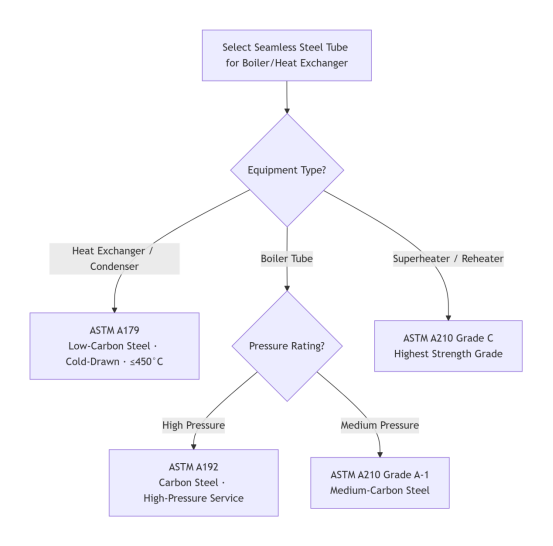
VIII. Material Selection Decision Tree
IX. International Standard Equivalents
| ASTM Standard | Chinese Equivalent Standard | Reference Chinese Grade | Remarks |
| ASTM A179 | GB/T 8163 / GB 3087 | 10# / 20# | Low-carbon, excellent weldability |
| ASTM A192 | GB 5310 | 20G | Special steel for high-pressure boiler tubes |
| ASTM A210 Grade A-1 | GB 5310 | 20G | Similar strength level |
| ASTM A210 Grade C | GB 5310 | 15CrMoG | Alloy steel, better high-temperature performance |
X. Why Choose Sanonpipe?
| Our Strengths | Details |
| Deep Standard Knowledge | Thorough understanding of ASTM A179/A192/A210 and ASME SA series, accurate interpretation of all technical requirements |
| Material Assurance | Complete material certificates available, including EN 10204 3.1/3.2 |
| Full Size Range | Supply OD 3.2–177.8 mm, wall thickness 0.9–25.4 mm seamless tubes |
| Fast Delivery | Supported by a 20,000-ton regular inventory; urgent orders shipped in 7-15 days |
| End-to-End Service | From inquiry, technical clarification, and quotation to documentation and logistics – one-stop delivery |
| Zero-Risk Commitment | 240+ internal quality control checkpoints; zero documentation discrepancies |
| CBAM Compliance Support | Assistance in preparing product carbon footprint data for smooth EU Carbon Border Adjustment Mechanism compliance |
XI. Contact Us
Sanonpipe is dedicated to providing global customers with high-quality seamless tubes conforming to ASTM A179/A192/A210. Whether you need heat exchanger tubes, boiler tubes, or superheater tubes, we offer professional technical support and flexible supply solutions.
Typical specification description example:
Seamless Cold-Drawn Low-Carbon Steel Tube 25.4×2.11 ASTM A179/A179M
Tianjin Sanonpipe Co., Ltd.
+86 22 58658800/+8615320100890
info@sanonpipe.com
www.sanonpipe.com
High Standards · Fast Delivery · Zero Risk · Green & Low-Carbon
Post time: Jul-08-2026


