
If you want to know more information, like quotation, products, solutions, etc., please contact us online.
Tianjin Sanon Steel Pipe Co., Ltd. is a stockist. Our stock factory is in Cangzhou City, Hebei Province. Our main sources of goods are boiler pipes, and the representative materials are ASTM A335 P5/P11/P91/P92, ASME SA-106/SA-106M GR.B, GB/T 3087-2008 10#/20#. The representative materials of pipeline pipes are API 5L, API 5CT, the representative materials of petroleum cracking pipes GB/T 9948 are 15MoG/12CrMoVG. GB/T 6479-2013 represents the material 10#/20#, heat exchanger tubes SA179/SA210/SA192, etc., mechanical tubes GB/T 8162 represent the material 10#/20#/Q345/42CrMo, EN10210 represents the material S355JOH/S355J2H, gas cylinder tubes GB1 8248, represent the material 34CrMo4/30CrMo.
In high-temperature and high-pressure industrial sectors, material selection is crucial for equipment safety and operational efficiency. T91 and P91, as two commonly used martensitic heat-resistant steels, are widely applied in power generation, petrochemical, and related industries. Although their names are similar and chemical compositions are close, their performance characteristics and application scenarios show significant differences.
Fundamental Differences Between T91 and P91
Definitions and Standards
T91 (T91 Tube ) is a tubing-grade steel primarily used for manufacturing boiler tubes, superheater and reheater tubes, and other tubular components. It conforms to ASME SA-213 standards.
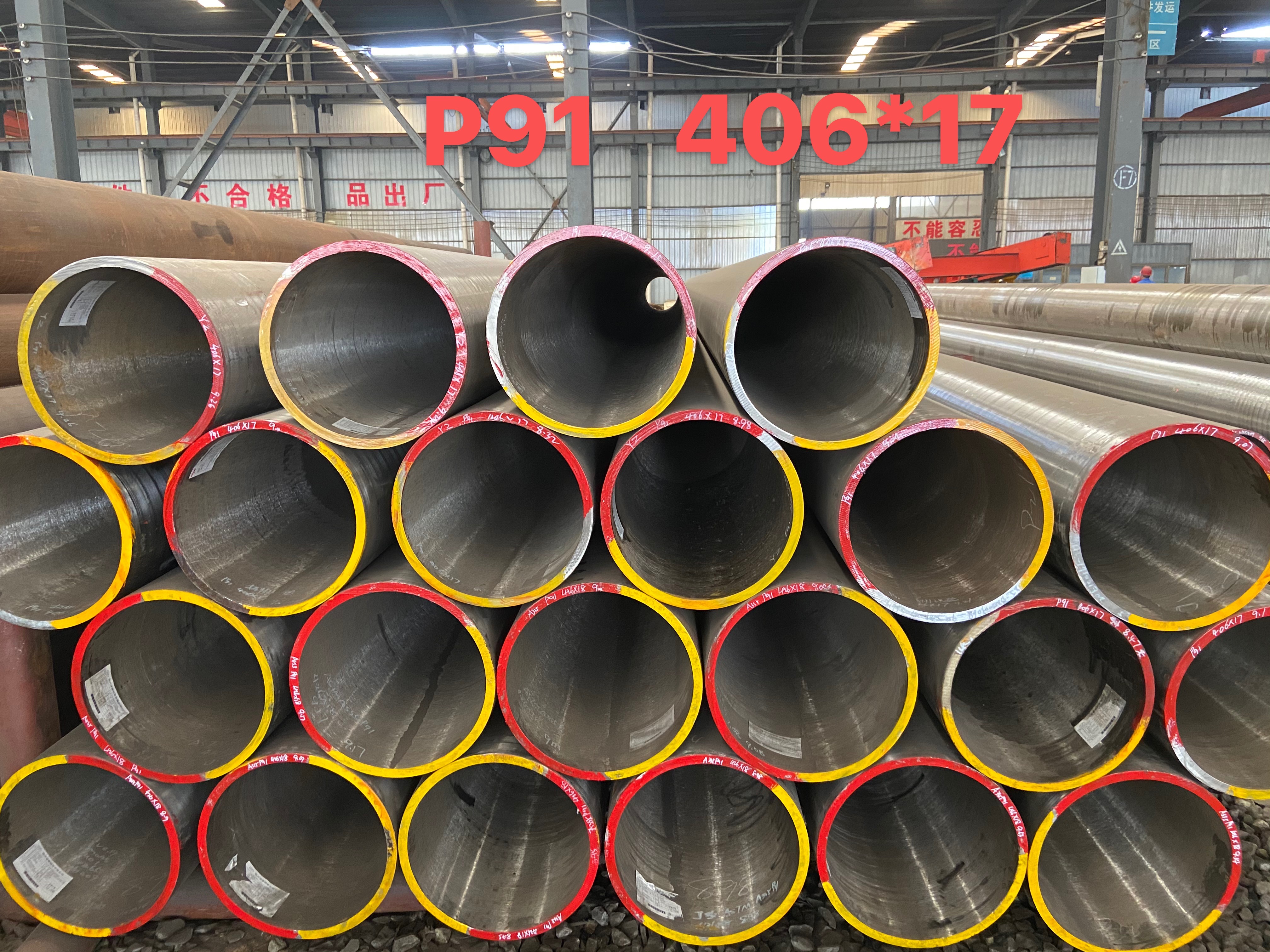
P91 (P91 Pipe ) is a piping-grade steel used for manufacturing main steam lines, headers, and other pressure components. It follows ASME SA-335 standards.
Chemical Composition Differences
Both steels share essentially the same chemical composition, with minor variations:
Aluminum content: T91 typically has lower aluminum content (≤0.04%), while P91 may have slightly higher levels (≤0.06%)
Manufacturing process: T91 is usually produced as seamless tubing, while P91 can be manufactured as either seamless or welded pipe
Mechanical Properties Differences
Strength requirements: P91 has slightly higher strength requirements to accommodate larger diameters and thicker walls
Impact toughness: P91 generally has stricter impact toughness requirements
Heat treatment: Both require normalizing and tempering, but specific parameters may vary based on section thickness
Application Areas
Primary Applications of T91
Superheater and reheater tubes in power plant boilers
High-temperature, high-pressure tubing systems
Heat exchanger tube bundles
Tubular components operating at 593-649°C
Primary Applications of P91
Main steam lines and hot reheat lines in power plants
High-temperature, high-pressure headers and manifolds
Piping in petrochemical hydrocracking units
Nuclear power system piping
Thick-walled pressure components operating at 593-649°C
Selection Considerations
Operating conditions: Temperature, pressure, and media corrosiveness
Component type: Piping, headers, or tubular heat exchange components
Manufacturing requirements: Weldability and formability
Economic factors: Initial cost and total lifecycle cost
Regulatory compliance: Must meet relevant industry standards and codes
Development Trends
With the advancement of supercritical and ultra-supercritical power generation technology, the application range of T91/P91 steels continues to expand. Current research focuses include:
Further improving long-term high-temperature creep strength
Enhancing long-term stability of welded joints
Developing more economical manufacturing processes
Exploring applicability in carbon dioxide cycle systems
Although T91 and P91 share similar chemical compositions, they have distinct differences in application scenarios, performance requirements, and manufacturing standards. Proper selection and use of these materials are essential for ensuring safe operation and extending service life of high-temperature, high-pressure equipment. Engineers should make informed choices based on specific application conditions, design requirements, and industry standards.
Post time: Dec-10-2025


