
If you want to know more information, like quotation, products, solutions, etc., please contact us online.
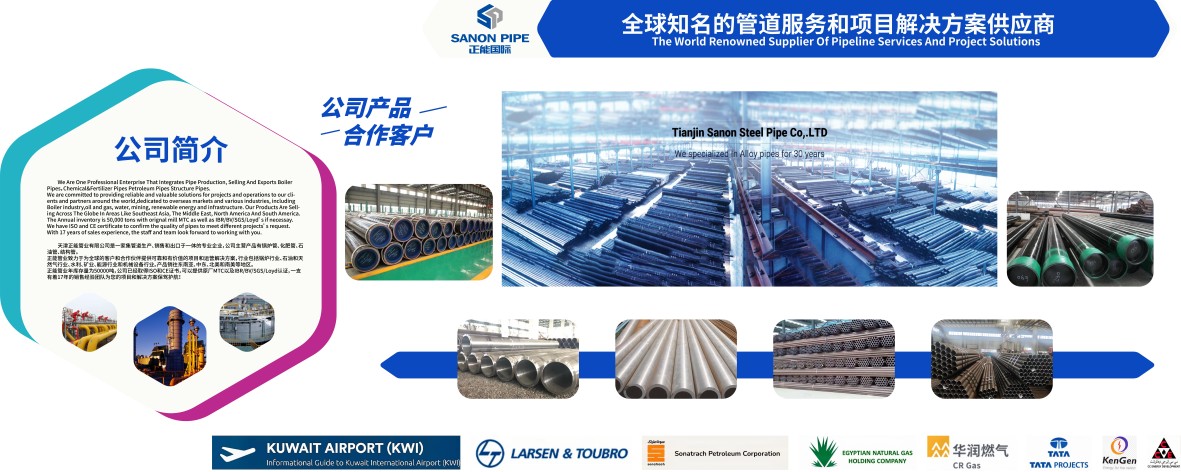
Tianjin Sanon Steel Pipe Co., Ltd. is a stockist. Our stock factory is in Cangzhou City, Hebei Province. Our main sources of goods are boiler pipes, and the representative materials are ASTM A335 P5/P11/P91/P92, ASME SA-106/SA-106M GR.B, GB/T 3087-2008 10#/20#. The representative materials of pipeline pipes are API 5L, API 5CT, the representative materials of petroleum cracking pipes GB/T 9948 are 15MoG/12CrMoVG. GB/T 6479-2013 represents the material 10#/20#, heat exchanger tubes SA179/SA210/SA192, etc., mechanical tubes GB/T 8162 represent the material 10#/20#/Q345/42CrMo, EN10210 represents the material S355JOH/S355J2H, gas cylinder tubes GB1 8248, represent the material 34CrMo4/30CrMo.
I. Introduction to A335 Alloy Steel Pipes
A335 alloy steel pipes refer to chromium-molybdenum ferritic alloy steel pipes that conform to the ASTM A335/A335M standard. Renowned for their exceptional performance at elevated temperatures, these pipes offer outstanding creep strength, oxidation resistance, and corrosion resistance. The most common grades are P11, P22, and P91, with P91 having become a critical material for modern power plants due to its superior strength and efficiency.
II. Key Application Fields
Designed specifically for extreme environments of high temperature and high pressure, the applications of A335 pipes are highly concentrated in the energy and heavy industries.
Power Station Boilers & Power Plants: This is the largest and most critical application for A335 pipes. They are extensively used in manufacturing superheaters, reheaters, main steam lines, and headers for power station boilers. These components must operate long-term under high temperatures (exceeding 500°C, even 600°C) and extreme pressure, where A335 pipes ensure the safety, efficiency, and long-term stability of the power plant.
Petrochemical Industry: In petrochemical plants, A335 pipes are used for pyrolysis furnace tubes, reformer tubes, and process piping. These applications also involve high temperatures and corrosive environments, such as in hydrocracking and catalytic reforming processes, where A335 pipes demonstrate excellent durability.
Other Industrial Sectors:
Metallurgical Industry: Used in piping systems for heating furnaces and heat treatment furnaces.
Nuclear Power Industry: Also finds applications in the conventional island systems of some nuclear power plants.
III. Global Export Market Analysis
As an industrial product with high technological content, the global trade flow of A335 pipes is closely linked to worldwide investment in energy infrastructure.
Major Exporting Countries/Regions:
China: One of the world's largest producers and exporters of steel pipes. Chinese manufacturers dominate the international market with a complete industrial chain, cost advantages, and continuously improving technical quality. Their products cover the full range of grades from mid-level P11 and P22 to high-end P91.
European Union (especially Germany and Italy): Home to historic steel giants like Germany's Mannesmann and Italy's Tenaris, known for high-quality and high-performance products, primarily targeting premium markets and local European projects.
Japan: Japanese steel companies (e.g., JFE, Sumitomo Metal) are renowned for top-tier quality consistency and R&D capabilities, holding strong competitiveness in high-end materials like P91 and P92.
India: A rapidly emerging pipe manufacturing nation, becoming a significant player in the international market with competitive pricing and gradually improving quality.
Major Importing Countries/Regions:
Middle East (e.g., Saudi Arabia, UAE, Qatar): Continuous investment in petrochemical projects and power plant construction makes this region a key import market for A335 pipes.
Southeast Asia (e.g., Vietnam, Indonesia, Malaysia): Rapid economic growth drives significant energy demand, with new coal-fired power plants and petrochemical facilities fueling imports.
North America: Despite having its own production capacity, there is significant import demand for cost-effective products, especially from China.
Other Emerging Markets: Countries in Latin America and the CIS region are potential importers of A335 pipes during their energy infrastructure upgrades.
Market Trends & Challenges:
Trends: The global energy transition is driving demand for high-efficiency, low-emission power plants, which directly benefits the market for high-performance A335 grades like P91 and P92. Furthermore, the retrofitting of aging power plants provides a steady market demand.
Challenges: Exporters face challenges such as rising international trade protectionism (e.g., anti-dumping duties), fluctuations in raw material prices, intense price competition, and increasingly stringent quality standards and certification requirements.
ConclusionA335 alloy steel pipes are the "arteries" of modern industry, particularly the energy sector. Their export market landscape reflects the dynamics of global industrialization and energy development. As developing countries continue to build energy infrastructure and developed nations refurbish their aging assets, the demand for high-performance A335 alloy steel pipes will remain steady. For exporters, enhancing product quality, complying with international standards, and offering competitive pricing are the keys to success in this market full of opportunities and challenges.
Post time: Oct-28-2025


